Septic Shock
Don't Leave God Alone: How to Get God's Attention, Remain in His Presence, and Even Change His Mind to Make a Difference in Your WorldSeptic Shock is the acute crisis that nearly killed the narrator’s father-in-law after an undiagnosed bowel rupture, yet it also becomes the defining ordeal in the family’s story of persistent prayer. The condition transforms an initially mysterious fever into a near-fatal medical emergency involving coma, extreme fever, poisoning, and multiple organ failure; his survival is subsequently interpreted by his family and surgeon as a “miracle” shaped by faith and prayer.
Onset and Medical Background
The crisis began during a family camping trip on July 4, when the narrator’s wife’s father developed a fever of 104 degrees. Several doctors could not identify its cause. Antibiotics brought the fever under control after three weeks, and he appeared to recover, although he remained weak. By the first week of December, however, the fever returned with far greater force. He woke faint and seeing spots, prompting his wife to call an ambulance.
The emergency investigation revealed that the illness was not a minor or temporary infection. Doctors initially suspected a cardiac problem and transported him by helicopter to another medical facility, where exploratory surgery found diverticulitis and a ruptured bowel. Months had passed with the rupture undetected, allowing the infection to become severe enough to produce septic shock. The narrator emphasizes the narrowness of the margin: had the patient gone back to bed that morning, he would have been dead by the time his wife returned from work that evening.
The Body in Crisis
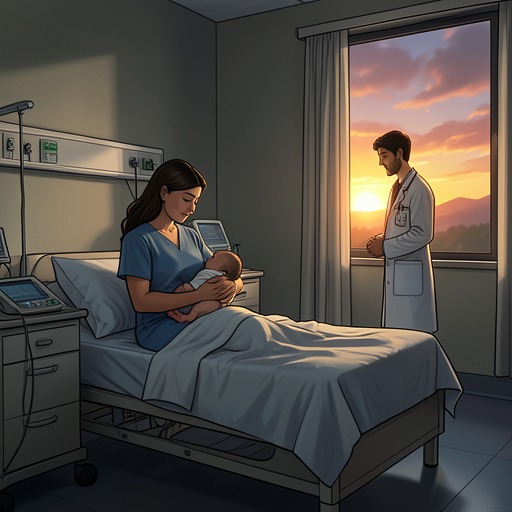
Surgery repaired the bowel, but the operation did not end the danger. His body had been so thoroughly poisoned by the infection that physicians placed him in a medical coma in an attempt to give him a chance to recover. He rapidly swelled to three times his normal size, and his fever rose to 105 degrees. Nineteen intravenous bags supplied medicines, fluids, blood, and food, while eight physicians worked on his case.
The infection then affected several vital systems. His liver, kidneys, and lungs began to shut down. He required full dialysis and a ventilator and experienced multiple organ and renal failure. The description presents septic shock not as an abstract diagnosis but as a cascading bodily collapse in which ordinary signs of life are sustained by machines, medication, and constant medical intervention.
Family, Prayer, and the Threshold of Death
The family treated the illness as a spiritual battle as well as a medical emergency. The narrator’s wife and her sister drove to see their father, while the narrator remained at home roughly three hours away caring for their two small children, including an infant. Prayer continued around the clock. The surgeon’s first report gave the patient less than a 50 percent chance of survival, but the narrator’s mother-in-law answered that her God was bigger than that and that the family should remain on the positive side of the odds.
The family’s language resisted the diagnosis’s apparent finality. After seven days, the narrator arrived with the children, and their grade-school-aged son told his grandfather, “Grandpa, you take up your bed and go home praising God!” The statement functions in the narrative as a declaration against the scene’s medical helplessness. The patient was still critically ill, but the family refused to treat the probability of death as the final interpretation of his condition.
The first two weeks brought little visible improvement. Doctors did not declare him better, and the family sometimes felt that its prayers were accomplishing nothing. Yet he remained alive beyond the period the family had feared. That survival became an early sign that change might be occurring invisibly, before recovery could be recognized. The account connects this delayed perception to the story of Lazarus, in which the approach of a miracle is not immediately understood by those waiting for it.
Recovery and Reclassification
The family began to interpret small spiritual impressions as signs that the crisis was turning: a vision, a dream, or a Scripture passage seemed to suggest that the obstacle was being removed. Brenda prayed that doctors would call her father “miracle man.” A doctor heard the request, and soon the medical staff began using that name. The change in designation preceded the visible recovery, allowing the patient’s identity in the family’s narrative to shift from doomed case to anticipated survivor.
The physical recovery occurred gradually. Medicines were reduced, machines were removed, and eventually he woke from the coma. Staff members were overjoyed, while a nurse who had not seen him for some time placed her hand over her mouth in disbelief and recognized him as the man from room ten. His surgeon later said that the recovery was not something the physicians had accomplished and described it as a work of faith and prayer. The narrator notes that most people do not normally survive septic shock, while also reporting that several years later the family’s “miracle man” was well.
Meaning Within the Book
Septic shock supplies the book’s most sustained example of a “Lazarus” situation: a treasured family hope appears to be dying while God seems silent, yet persistent prayer continues until the threatened life returns. The illness therefore links medical crisis with the book’s larger principle of refusing to leave God alone. Prayer is not presented as a brief response to alarming news but as a continuous practice maintained through uncertainty, delayed results, and worsening symptoms.
The account also places several forms of authority beside one another. Doctors diagnose, operate, provide intensive support, and calculate survival chances; family members interpret the crisis through faith, prophecy, and prayer; and the surgeon ultimately acknowledges that the outcome exceeded ordinary medical expectation. The narrative does not erase the machinery, medicines, surgery, dialysis, ventilator, or physicians. Instead, it makes the medical apparatus the visible setting in which the family’s religious interpretation of extraordinary survival takes shape.
Within the wider pattern of the book, the episode echoes other emergencies: the young man who survives a highway collision, the newborn girl given an 11 percent chance of living, the woman with the issue of blood whose condition “grew worse,” and public dangers for which collective prayer is urged. Each case converts escalating risk into a summons to continued reliance on God. Septic shock is the most extensive of these cases because it combines delayed diagnosis, septic poisoning, medical coma, a 105-degree fever, nineteen intravenous bags, dialysis, ventilation, and the shutdown of three major organ systems before arriving at recovery.
The condition thus marks the point at which mortality, medical probability, family grief, and religious hope meet. Its narrative force comes from the reversal: the same body described through shock, coma, swelling, fever, and organ failure later wakes, leaves intensive care, and remains well years afterward. The diagnosis names the extremity of the danger; the recovery becomes the event through which the family claims that persistent faith and prayer can bring a seemingly dead dream back to life.